If you are planning to build a new home in Fayetteville, one of the first questions is usually simple: how long will it actually take? That matters whether you are timing a move, coordinating a home sale, or trying to line everything up with military relocation orders. The good news is that a straightforward new-home build can follow a fairly predictable path, but local permitting, lot conditions, utilities, and inspections all affect the schedule. Here is what you can realistically expect in Fayetteville, Cumberland County, and the surrounding Fort Bragg area. Let’s dive in.
What Drives the Timeline in Fayetteville
Before anyone can estimate your timeline, the first step is figuring out who has jurisdiction over the property. Inside Fayetteville city limits, the City of Fayetteville handles building plan review and inspections. In unincorporated parts of Cumberland County, the county handles inspection services instead. You can review the city’s permitting overview on the City of Fayetteville Development Services page.
For many single-family homes on conforming lots, the process is more straightforward than people expect. Fayetteville exempts standard single-family homes on conforming lots from site plan review, which can make the front end more predictable than projects involving subdivisions or major site plan approvals. That is one reason some homes move smoothly while others take longer before construction even begins.
A Realistic New Home Timeline
The clearest public benchmark for build duration comes from regional Census data. In the South, U.S. Census construction data shows that 52% of one-unit homes completed in 4 to 6 months from construction start in 2024. Another 17% finished in 7 to 9 months, 6% took 10 to 12 months, and 9% took 13 months or more.
That means the actual construction phase is usually measured in months, not weeks. In Fayetteville, the permit review itself can move much faster than the physical build. The city states that single-family homes are reviewed within 2 business days, while Cumberland County says permit approval generally takes 3 to 4 days, assuming the application is complete.
Phase 1: Pre-Construction and Permit Prep
The pre-construction phase often decides whether your timeline stays on track. Before the permit can be issued, the application usually needs the lot address, parcel identification number, contractor information, utility or septic details, termite treatment type, plot plan, and construction plans. Cumberland County outlines these requirements in its single-family dwelling guidance.
If the home will use a septic system, the site must be approved by the Health Department before the building permit can be issued. That adds an extra checkpoint early in the process. If you are building in an area with public utilities, you still want to confirm service availability and connection timing before assuming construction can start immediately.
Floodplain Review Can Add Time
One of the biggest local variables is floodplain status. Cumberland County requires a Floodplain Development Permit before construction begins in a Special Flood Hazard Area, and the county will not issue the building permit until that floodplain permit is in place. You can review those requirements on the county’s floodplain administration page.
If your lot is clear of floodplain issues, that removes a major source of delay. If it is not, expect added review time before you reach the permit stage.
Subdivision Status Matters Too
If your lot is in an already approved subdivision, the path is usually simpler. If the property is part of a new subdivision or involves new street connections, Fayetteville may require Technical Review Committee review. According to the city’s site plan and subdivision approval process, the TRC meets every Wednesday, formal action is due within 30 days of submission, and resubmittals are due within 45 days.
That does not apply to every new home, but when it does, it can stretch the timeline well beyond a basic permit review. This is why two homes in the same market can have very different schedules.
Phase 2: Permit Approval
For a standard single-family home, permit review is often one of the shorter phases. The City of Fayetteville says single-family homes are reviewed within 2 business days, and Cumberland County notes that permit approval generally takes 3 to 4 days. Both jurisdictions also say inspections are typically scheduled within 48 hours of request through their normal process.
That speed can be encouraging, but only if your file is complete. Missing plans, unresolved septic questions, floodplain requirements, or subdivision issues can slow the process much more than the posted review window.
Phase 3: Construction and Inspections
Once the permit is issued, construction can begin. Fayetteville’s development guide notes that the building permit is typically the last step before actual construction starts, and inspections must happen at each required phase before work is concealed. The city outlines this in its development guide.
Cumberland County’s residential guidance lists a typical sequence of inspections that includes:
- Temporary pole
- Footing and zoning
- Slab
- Foundation
- Floor framing
- Electrical rough-in
- Plumbing rough-in
- Mechanical rough-in
- Gas piping
- Framing
- Insulation
- Water and sewer
- Final inspection
Each inspection is a handoff point. If the work is ready, the schedule moves forward. If something is not ready or needs correction, the next phase can be pushed back.
Why Construction Still Takes Months
Even when permitting is relatively fast, the build itself takes time because every phase depends on the previous one. Site work must happen before foundation work. Rough-ins must be completed before insulation and drywall-related progress can continue. Finals cannot happen until all major systems and finishes are complete.
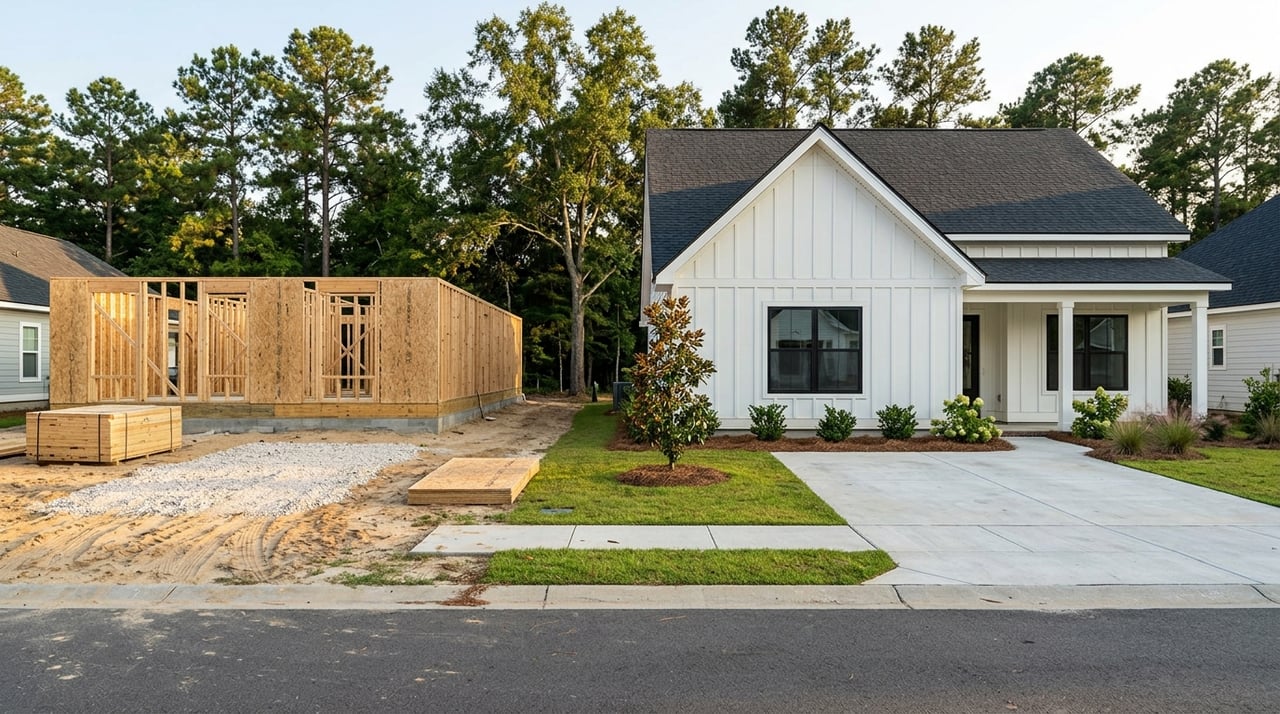
That is why the regional data is so useful. In a market like Fayetteville, a well-positioned lot and a straightforward home plan can still take several months from start to finish, even when the process is moving normally.
Phase 4: Certificate of Occupancy and Closing
A home is not ready for move-in the moment construction crews wrap up. In Fayetteville, no new building may be occupied until the city issues a Certificate of Occupancy or Compliance after the final inspection confirms code compliance. The city explains this on its building plan review and inspections page.
Cumberland County says the Certificate of Occupancy is available three days after inspection. Fayetteville also notes that a Temporary Certificate of Occupancy may be issued for up to 60 days if only minor items remain and there are no life-safety issues.
After occupancy approval, you still have the closing process. According to the Consumer Financial Protection Bureau’s closing guidance, buyers should expect lender document requests, homeowner’s insurance, title insurance, document review, final signing, and generally an appraisal required by the lender. For move-in-ready new construction, this can be the main remaining phase after the physical home is complete.
Utility Setup Can Affect Move-In
Utility timing is easy to overlook until the last minute. Fayetteville PWC states that all new construction locations in the city and county must have an inspection on file before electric service can be activated. PWC also says any work inside a meter base must be inspected before power can be supplied, and start or transfer requests trigger a customer-service callback within 24 to 72 business hours. You can review that process on the Fayetteville PWC inspections and permitting page.
That is a strong reason to schedule utility setup before move-in week. Even if the house is otherwise complete, delayed utility coordination can hold up your actual move.
Special Timing for Military Moves
In the Fayetteville market, military relocation often shapes the homebuilding timeline as much as construction itself. The Army states that PCS orders are generally provided 120 days before report dates, and Fort Bragg’s Housing Services Office guidance says service members should report there before making off-post housing arrangements. The Army’s 2025 redesignation update is available on Army.mil.
If you are planning around a PCS date, lease expiration, or sale of another home, the key is to build in cushion. Even a well-managed timeline can shift when inspections, approvals, or final utility coordination take longer than expected.
What Usually Makes a Fayetteville Build Faster
Some projects are naturally more predictable than others. In general, a build is easier to schedule when you have:
- A conforming lot
- An already approved subdivision
- No floodplain issue
- Clear utility access
- Complete permit documents submitted early
- A realistic closing and move-in plan
This is often the smoothest path for a production or semi-custom single-family home.
What Commonly Slows the Schedule
The biggest delays usually happen when extra approvals are needed. Common timeline stretchers include:
- Building in a Special Flood Hazard Area
- Waiting on septic or utility approvals
- New subdivision or street-connection review
- Incomplete permit applications
- Inspection corrections between phases
- Last-minute utility activation requests
These issues do not always derail a project, but they can add time at several points instead of just one.
How to Plan Your Timeline More Confidently
If you are trying to estimate your move, it helps to think in stages instead of one single date. Start with lot review and permitting. Then allow for the construction period, followed by occupancy approval, utilities, and closing.
For many buyers, especially relocation households, the smartest approach is to work backward from the date that matters most. That might be a report date, lease end, or school-year transition. Once that target is clear, you can better judge whether a move-in-ready home, a home already under construction, or a build from the ground up fits your timeline best.
When you want fewer handoffs and a more coordinated process, working with a team that understands permitting, utilities, construction sequencing, and resale timing can make the experience feel much more manageable. If you are exploring new construction in Fayetteville or north Cumberland County, Ace Development Group offers a hands-on, single-point-of-contact approach designed to help you move from planning to closing with more clarity. Schedule a consultation with Ace and start your build or tour a home today.
FAQs
How long does it take to build a new home in Fayetteville?
- For the construction phase, regional Census data for the South shows many one-unit homes finish in 4 to 6 months, but the full timeline can be longer when you include permitting, inspections, utilities, and closing.
How long does permit approval take for a single-family home in Fayetteville?
- The City of Fayetteville says single-family homes are reviewed within 2 business days, and Cumberland County says permit approval generally takes 3 to 4 days when the application is complete.
What can delay a new home build in Cumberland County?
- Floodplain permits, septic approvals, subdivision review, incomplete applications, inspection corrections, and utility setup can all add time.
Do you need a Certificate of Occupancy before moving into a new home in Fayetteville?
- Yes. Fayetteville says a new building cannot be occupied until a Certificate of Occupancy or Compliance is issued after final inspection.
How do utility connections affect a new construction move-in timeline in Fayetteville?
- Fayetteville PWC says new construction must have an inspection on file before electric service can be activated, so utility setup should be planned before move-in week.
How should military buyers plan a new construction timeline near Fort Bragg?
- Since PCS orders are generally provided 120 days before the report date, it helps to coordinate your build or closing timeline early and leave room for permitting, inspections, and final move-in steps.